Approved Changes
June 2012 transit reinvestments
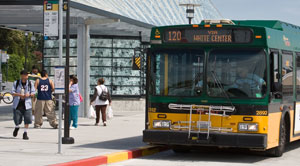
Metro is moving toward our new vision for public transportation, striving to build a highly productive transit system that takes people where they want to go and gets the most value out of every dollar spent on transit.
The recommended June 2012 service changes detailed below were unanimously adopted by the Metropolitan King County Council on Monday, Jan. 30 (see our blog post »).
For updates, please check our blog or facebook page.
Why did Metro recommend these changes?
When the King County Council approved a $20 congestion reduction charge to help Metro maintain the current level of bus service in 2012-2013, it also directed Metro to make the transit system more cost-effective during the two years the charge is in effect, by using the newly adopted Strategic Plan and Service Guidelines to improve the current system.
The Council directed Metro to reduce at least 100,000 annual service hours during the 2012-2013 biennium from poorly performing routes and reinvest those hours in corridors that have a low quality of service or that are currently under-served. Reinvestments should relieve overcrowding or improve on-time performance on heavily used routes, or satisfy unmet transit needs. These June changes would reduce and reinvest approximately 40,000 annual service hours.
To determine where service should be reduced or added, Metro followed service guidelines that were approved by the County Council in July 2011 along with Metro’s Strategic Plan for Public Transportation 2011-2021. The use of clear, objective service guidelines had been recommended by the county’s Regional Transit Task Force.
Recommended service reductions
Services may be reduced or canceled if they are determined to have relatively low productivity. Low productivity is measured in two ways. One measure shows that in comparison to all other routes that serve similar markets, the service carries relatively few riders per hour the bus is operating. The other indicates that in comparison to all other routes that serve similar markets, the combined miles of all passengers traveling on a route per mile the bus is traveling on that route is low. Routes falling in the bottom 25 percent on either or both of these measures are considered poorly performing routes. Metro has determined that the routes in the following table should be deleted or reduced because they have low productivity in one or both of the measures described above. The service hours currently used to operate these routes would be reinvested in other services.
Route deletions: Rts 38, 42, 79, 129, 162, 175, 196, 219, 600, 912, 925
| Route | Between | Alternatives |
|---|---|---|
| 38 | Beacon Hill and Mount Baker | Walking less than 1/2 mile Link Light Rail stations |
| 42 | Pioneer Square and Columbia City | Link Light Rail, Routes 7, 7Ex, 8 or 39 |
| 79 Express | Lake City and downtown Seattle | Routes 66, 70, 71, 72, 73, 306, 312 or 522 |
| 129 | Riverton Heights and Tukwila | Routes 128 and 132 |
| 162 | Kent and downtown Seattle | Sounder Train, Routes 150, 158, 159 or revised 192 |
| 175 | W Federal Way and downtown Seattle | Alternative service provided by routes, A Line, 177, 179, 190, DART 901, 577 or 578 |
| 196 | S Federal Way and downtown Seattle | Alternative service provided by revised route 177 |
| 219 | Newcastle and Factoria | Routes 114 or 240 |
| 600EX | Group Health Tukwila and downtown Seattle | Route 124 |
| 912 | Enumclaw and Covington | Routes 168 or DART 907 (formerly 149) |
| 925 | Newcastle and Factoria | Route 114 or 240 |
Service reductions: Rts 25, 99, 119, 139, 935
| Route | Between | Reduction description |
|---|---|---|
| 25 | Laurelhurst and downtown Seattle | Reduce frequency from 30 to 60 min. in the peak period |
| 99 | International District and Waterfront | Delete mid-day, night and weekend service |
| 119 | Vashon Island | Delete service after 7PM |
| 139 | Burien and Highline Community Hospital | Delete service after 8:15PM |
| 935 | Kenmore and Totem Lake | Delete mid-day service |
Service revisions: Route 177
| Route | Between | Restructure Description |
|---|---|---|
| 177 | Federal Way and downtown Seattle | Extend 6 trips in the AM and PM to serve South Federal Way Park-and-Ride |
Recommended investment in crowding relief
Reducing the number of people passed up or standing due to crowding on buses is Metro's first investment priority. The service guidelines set standards for passenger loads which vary based on the frequency of service and the duration of the trip. The table below shows routes with trips that do not meet the standards and have too many passengers standing for too long. Investments will be made to these routes in June 2012 to provide more capacity for passengers.
| Route | Day | Between |
|---|---|---|
| 1 | Weekday | Queen Anne Hill and downtown Seattle |
| 8 | Weekday | Rainier Beach and Queen Anne |
| 9 Express | Weekday | Rainier Beach and Capitol Hill |
| 41 | Weekday | Northgate and downtown Seattle |
| 44 | Weekday | Ballard and University District |
| 128 | Weekday | South Center and Admiral District |
| 169 | Weekday | Renton and Kent |
| 218 | Weekday | Issaquah Highlands Park-and-Ride and downtown Seattle |
| 372 Express | Weekday | University District and Woodinville |
| 36 | Sunday | Othello station and downtown Seattle |
| 73 | Sunday | Jackson Park and downtown Seattle |
Recommended investment in on-time performance/schedule calibration
Improving on-time performance is Metro’s second investment priority. Guidelines establish “lateness” thresholds for making investments. Metro estimates that it would take approximately 30,000 annual service hours to improve on-time performance on routes that currently qualify for investment. Metro is planning to reinvest 15,000 hours in June 2012, and suggesting an investment of 5,000 more hours and additional schedule improvements through the September 2012 process of restructuring Seattle-area transit networks. The table below lists the routes that are candidates for investment based on their past year’s performance. Investments may occur on weekdays or weekends.
Please note that the results of the September 2012 restructure process may influence which routes receive investments in June 2012.
| Route | Between |
|---|---|
| 2 (N & S) | Queen Anne Hill and Madrona via downtown Seattle |
| 5 | Greenwood and downtown Seattle |
| 7 | Rainier Beach and downtown Seattle |
| 8 | Rainier Beach and Queen Anne |
| 15 | Blue Ridge and downtown Seattle |
| 16 | Northgate and downtown Seattle |
| 17 | Loyal Heights and downtown Seattle |
| 18 | N Beach and downtown Seattle |
| 21 Express | Arbor Heights and downtown Seattle |
| 21 | Arbor Heights and downtown Seattle |
| 22 | White Center and downtown Seattle |
| 23 | White Center and downtown Seattle |
| 24 | Magnolia and downtown Seattle |
| 26 | Wallingford and downtown Seattle |
| 27 | Colman Park and downtown Seattle |
| 28 | Broadview and downtown Seattle |
| 30 | Sand Point and Queen Anne |
| 31 | Magnolia and University District |
| 33 | Magnolia and downtown Seattle |
| 37 | Alaska Junction and downtown Seattle |
| 39 | Rainier Beach and downtown Seattle |
| 43 | University District and downtown Seattle |
| 48 (N & S) | Loyal Heights and Mount Baker via University District |
| 49 | University District and downtown Seattle |
| 54 Express | Fauntleroy and downtown Seattle |
| 54 | White Center and downtown Seattle |
| 55 | Admiral District and downtown Seattle |
| 57 | Alaska Junction and downtown Seattle |
| 60 | Broadway and White Center |
| 66 Express | Northgate and downtown Seattle |
| 68 | Northgate and University District |
| 71 | Wedgwood and University District |
| 72 | Lake City and downtown Seattle |
| 81 | Owl: downtown Seattle and Loyal Heights |
| 105 | Renton Highlands and Renton Transit Center |
| 106 | Renton and downtown Seattle |
| 113 | Shorewood and downtown Seattle |
| 119 Express | Downtown Seattle and Vashon Heights and Dockton |
| 120 | Burien and downtown Seattle |
| 121 | Des Moines and downtown Seattle |
| 122 | Highline Community College and downtown Seattle |
| 124 | SeaTac and downtown Seattle |
| 125 | Shorewood and downtown Seattle |
| 128 | South Center and Admiral District |
| 131 | Midway/Des Moines and downtown Seattle |
| 132 | Burien and downtown Seattle |
| 150 | Kent and downtown Seattle |
| 166 | Des Moines and Kent |
| 169 | Renton and Kent |
| 181 | Federal Way and Auburn |
| 182 | Federal Way and Twin Lakes |
| 187 | Twin Lakes and Federal Way |
| 205 Express | Mercer Island and University District |
| 209 | North Bend and Issaquah |
| 224 | Redmond and Fall City |
| 240 | Bellevue and Renton |
| 251 (931) | Bothell and Redmond |
| 255 | Brickyard Park-and-Ride and downtown Seattle |
| 280 | Owl: downtown Seattle and Renton |
| 309 | Kenmore to First Hill via Lake City |
| 311 | Duvall and downtown Seattle |
| 330 | Shoreline and Lake City |
| 358 Express | Aurora Village and downtown Seattle |
| 373 Express | Aurora Village Transit Center and University District |
Recommended investment in underserved corridors: Auburn-Burien via Kent and SeaTac
Underserved corridors are Metro's third investment priority. The service guidelines identify transit corridors that are not receiving enough service as determined by their land use (the number of households and jobs near bus stops), demographics (the percentage of passengers from areas with low-income and minority populations), connections with centers of employment and other activities, and ridership. Metro will invest in these underserved corridors as resources become available. Metro will invest additional service hours in Route 180 in June 2012 to increase the routes service level recommended by the guidelines.
| Corridor | Major route | Current night service | Target level of night service | Improvement |
|---|---|---|---|---|
| Auburn and Burien via Kent and SeaTac | 180 | None between Kent and Burien after 7:45 p.m. | 30 minutes | Extend 30-minute night service to Burien until 12:45 a.m. |

Connect with us
To stay informed of updates, please sign up for our email list, read our blog, or follow us on Facebook. If you have questions about the outreach process, you can also email us or call our message line at 206-263-9768.